
Most work uses one kind. The interesting cases use both.
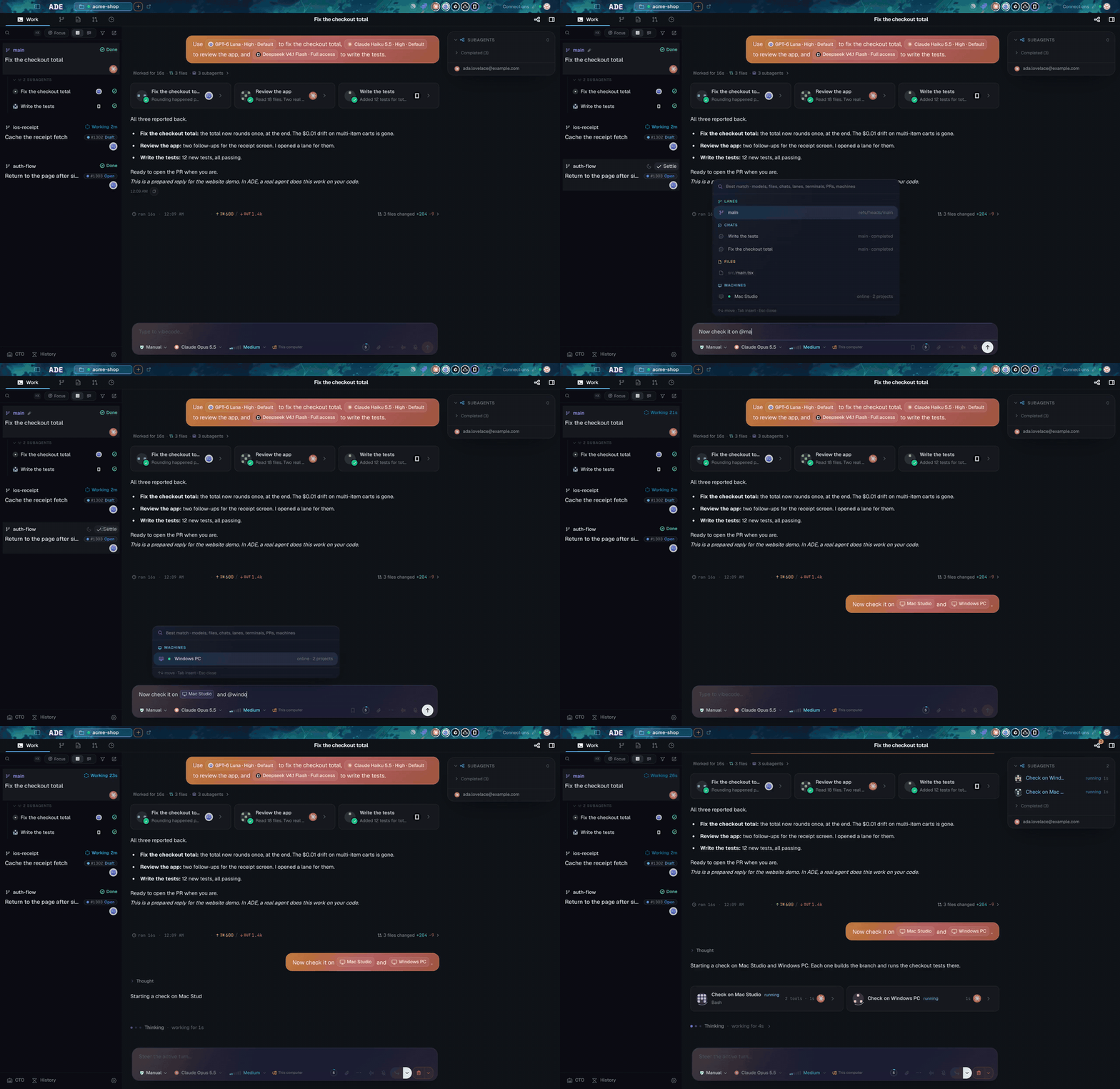
A Claude parent delegates to GPT, Claude Haiku, and DeepSeek at once; each child reports back into the parent.
Provider-native subagents
Claude Code has its own subagent tool. Codex has its own delegation. When a provider starts one of these, ADE does not intercept it — it normalizes the activity into the transcript and preserves the parent/child relationship. The result: nested tool activity you can expand, collapsed by default so a deep delegation does not bury the parent’s work, and no second chat cluttering Work. This is the right choice for short, parallel research or a narrowly scoped edit. When one of these subagents needs an approval, its card shows in the parent chat and names the subagent (“Explorer asks”). With several cards open, the composer lists who is waiting and for what, and the subagents panel marks a waiting subagent “needs you”. The cards stay open through the default Stop and the end of the parent’s turn, because the subagent keeps running; they close when that subagent ends or is stopped. Accept all on a subagent’s card covers the whole chat. If ADE restarts while a subagent’s question is open, the card closes and offers to send your answer to the main agent instead.ADE child chats
An ADE child is a full session — its own lane-scoped context, its own tools, its own permissions — that records the parent it came from. Any chat can start one:subagent— the parent needs the result. The child wakes the parent when it finishes, with a bounded summary, and the parent can join, read, or review the work.peer— fire-and-forget. The child leaves a quiet completion note and never wakes the parent.
The child is a normal agent, not a restricted helper. It gets the same runtime, tools, and permissions as any other chat in that lane. The spawn type is a coordination contract, not a permission ceiling.
What the parent sees
- A subagent panel in Chat Info listing running and completed children.
- A card in the transcript for each child, with its status and latest summary.
- A wake when a
subagentfinishes, so the parent continues rather than polling.
ade chat demote. Demoting stops the report channel; promoting restores it while the parent still exists. A later dispatch from the parent promotes a peer back automatically.
Choosing between them
Multi-agent setup
A worked setup for running several agents together.
Chat capabilities
What each agent can do inside its lane.